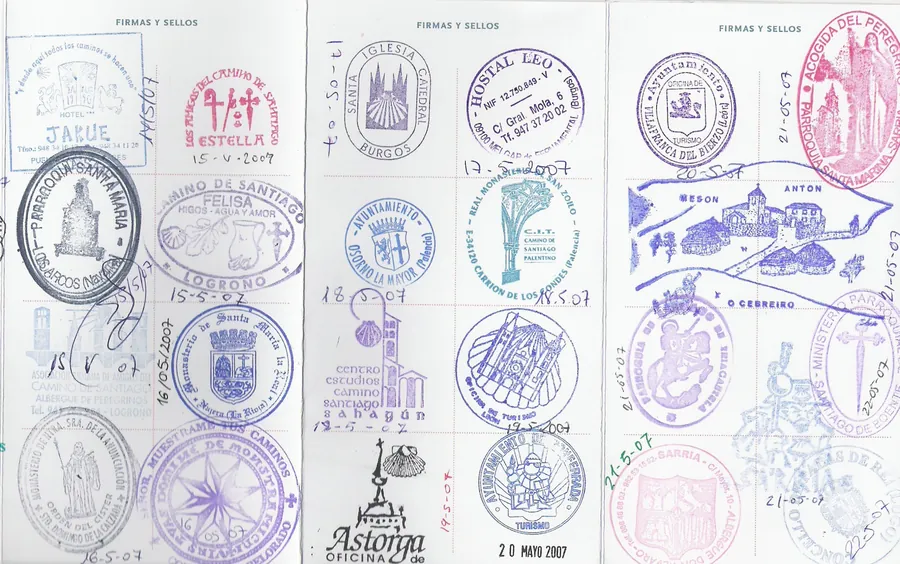
The pilgrim credential, sometimes called the pilgrim passport, travels with almost every walker on the Camino de Santiago. This small concertina-folded booklet, stamped at every stage, serves both as proof of the route walked and as a personal keepsake. It is a companion piece to this blog's home page overview of pilgrim traditions on the way through Moissac.
What the credential is for
The credential has two distinct purposes. First, it documents the walk stage by stage, through the dated stamps collected along the route. Second, and more practically, it is required to obtain the Compostela, the certificate awarded on arrival in Santiago de Compostela: pilgrims arriving on foot must show at least the last 100 kilometres walked, with a minimum of two stamps per day over that final stretch. Across the rest of the route, one stamp a day is usually enough to keep a coherent record. Many walkers keep the booklet mainly for themselves, as a travel diary, without necessarily aiming for the Compostela at all.
Where to get a credential before setting out
In France, the credential is most often issued by pilgrim associations dedicated to the Camino - the "associations des amis du chemin de Compostelle" found in many towns, particularly near classic starting points such as Le Puy-en-Velay. Some tourist offices in departure towns, along with a few parish welcome desks, can also provide one. The booklet is usually handed over for a symbolic fee or donation, which helps fund these volunteer-run associations. It is best to get one before leaving rather than counting on finding one along the way, though some gîtes d'étape or pilgrim welcome points can occasionally supply one if needed.
Collecting stamps along the way
Once on the road, every stage is a chance to get the credential stamped: churches, abbeys and tourist offices, but also some gîtes d'étape, cafés and shops used to pilgrim traffic, will gladly add their own stamp, often dated and illustrated with a local motif. There is no strict rule on how many stamps to collect per day before the final 100 kilometres, though a daily stamp keeps a clear and continuous record of the walk. On that last stretch before Compostela, however, two stamps per day are required to receive the Compostela - a rule set by the pilgrims' office in Santiago that is worth checking before arrival, in case it changes.
Getting stamped in Moissac
As in most stages on the Camino, it is usually possible to get a credential stamped in Moissac, typically at Saint-Pierre Abbey or at the town's tourist office. The exact arrangements - the precise location, opening hours, who to ask - vary by season and can change from year to year. The most reliable approach is to check locally on arrival, at the tourist office or with your accommodation, rather than relying on information found online months in advance. For more practical tips on preparing your stop in Moissac, see Good to Know.
Looking after the credential on the road
This small paper booklet deserves a little care: slipping it into a plastic sleeve or a waterproof pouch protects the stamps from rain and sweat, both common risks over several weeks of walking. Many pilgrims keep it within reach in an outer pocket of the backpack rather than buried at the bottom, so they do not have to unpack everything at each stop. If the booklet fills up before arrival, some associations issue a second one, to be glued or stapled to the first.
In brief
- The credential records the route walked and is required to obtain the Compostela in Santiago.
- It is usually issued by pilgrim associations before departure, for a symbolic fee or donation.
- Two stamps a day are required on the last 100 kilometres before Compostela; one a day is enough on the rest of the route.
- In Moissac, stamping is usually possible at the abbey or the tourist office - check opening hours locally.
- A waterproof pouch protects the booklet from rain and sweat over several weeks of walking.